
Mission
To enrich our community in its natural environment by conserving the indigenous bush, enhancing its future and improving its accessibility.
Introduction
Indigenous bush areas, both public reserves and privately held, provide an important link to maintaining and preserving the natural ecosystems and heritage of native plant and bird life in this country.
In the Tawa suburban area of Wellington City there are few enough remnants of bush and these require proactive management if they are going to survive the rigors of surrounding commercial and rural development and uncoordinated community pressure.
The bush remnants in Tawa also provide important linkages and corridors between the larger bush areas around Colonial Knob to the north and the Wellington City Inner Town Belt to the South.
It is only through the continued vigilance of the local community that remaining bush remnants will be protected and where possible expanded to form more viable ecological communities for the benefit of future generations.
Reserves
The primary reserves of interest in the Tawa basin to the Friends are the following: –
- Charles Duncan Reserve
- Forest of Tawa (Te Ngahere-o-Tawa)
- Larsen Crescent Reserve
- Pikitanga Reserve
- Redwood Bush Reserve
- St Anne’s Reserve
- Wadham Grove Reserve
- Wilf Mexted Reserve
- Willowbank Reserve
- Woodburn Reserve
History
The Friends of the Tawa Bush Reserves Inc was formed out of an inaugural public meeting on the 27th February 2002. Prior to this there existed an interim committee whose initial focus was to preserve the widely acclaimed, botanically unique in the Wellington region, indigenous bush remnant of Larsen Crescent Reserve that was under threat from urban development. It was recognised that such preservation and conservation could not be sustained in the longer term without increasing the size of the ecology catchment to at least include the Redwood Bush Reserve. Community input to the founding public meeting further extended the catchment of the friends group to the wider Tawa basin area.
Our plan is to achieve these ideals by:
- active guardianship on matters concerning the indigenous bush reserves of Tawa;
- preserving, restoring and enhancing the essential character and beauty of the indigenous bush reserves of Tawa;
- working in close association with the Council; and by
- ensuring that the indigenous bush reserves of Tawa remain an inspiration for today’s citizens, and for future generations.
Our goals and objectives are:
Guardianship
- To uphold the ideals for the ecological preservation of indigenous bush remnant areas as special areas to be preserved for future generations.
- To provide for the conservation of the remaining bush remnants within the area of the Tawa basin, and to encourage where appropriate the addition of land to the Tawa reserves as a means to linking together smaller areas to provide more ecologically sustainable areas under a common management.
- To oppose any misappropriations or misuse by the Crown or its agencies, the Council, or by corporations, groups or individual citizens.
Education and Knowledge
- To encourage interest, use, and research into the historical, cultural, scientific, ecological, botanical and recreational aspects of the bush areas of Tawa.
- To broaden community and Council knowledge and understanding of bush reserves within the Tawa vicinity and the ecological need for the preservation of such bush remnants through publications, events, publicity and other appropriate means.
- To encourage residents and visitors to use and enjoy the Tawa bush reserves as part of the City of Wellington’s attractions, heritage and beauty within the constraints of also maintaining their conservation.
Activities
- To actively participate in the management, maintenance, development and monitoring of the bush reserves of the Tawa basin in association with the Wellington City Council and Wellington Regional Council and other bodies sharing our vision.
Projects
- To foster and sponsor special projects to restore and enhance the Tawa bush reserves, in partnership with individuals and other groups.
Membership
- To promote membership of the Friends to all individuals and groups who share the ideals of the Friends and contribute to its objects.
Structure
- To operate as an independent Incorporated Society.
Strategy
In the late 1990s, one of Tawa’s few stands of remnant forest was at immediate risk of being felled for a housing development. Residents stepped in to save it for future generations, and Friends of Tawa Bush Reserves was born.
Twenty years on, our work has extended to cover the length and breadth of Tawa. But the future of much of Tawa’s bush and forest is by no means certain. Much of the land is privately held and could be developed.
In response to this challenge, we engaged a well-respected ecological consulting firm, Wildlands, to work with us to develop a strategic plan. This strategic plan helps us, and our partners to focus on how we can ensure the long-term sustainability of Tawa’s bush, as well as improve the resilience and effectiveness of our own organisation.
Strategic Plan
The strategic plan can be accessed here:
We thank the Lotteries Commission, Wellington City Council and Tawa Community Board for generously providing the financial support needed to develop the plan.
Current Committee
The management committee of the Friends of Tawa Bush Reserves Inc. for 2021 is as follows:
| Name | Position |
| John Burnet | President |
| Geoff Mills | Secretary |
| Chris Paice | Treasurer |
| Gary Beecroft | Vice-president |
| Richard Herbert | Working bees coordinator and Facebook page |
| Andrew Liley | Tracks co-ordinator |
| Damian Hewett | Membership |
| Andrew Hunt | Newsletter editor |
| Extended Committee | |
| Fiona Drummond | Willowbank Reserve Care Group |
| Frank Williams | WCC representative |
| Martin Glaeser | Predator Control Co-ordinator |
| Other roles | |
| Joanne Youthed & James Wright | Greenhouse plant propogation managers |
Founding and Life Members
Friends of Tawa Bush Reserves has some amazing people involved, here’s a list of our awesome Founding and Life Members:
Founding Members
- Allan Todd (d 2013 aged 81yrs). http://www.tawalink.com/2mins/tawanews_20130626.pdf
- Brian Carter
- Fraser Jackson
- Jo Hoshek
- Damian Hewett
- Marjorie Todd
- Ken Matthews
Our incredible important members and Life Members (Past and Present) and their awesome work
– what we enjoy today is in so many way thanks to them
Brian Carter
Farewell and acknowledgement as in the FOTBR Newsletter May 2025
We mourn the loss of Brian Carter in April and celebrate the major contributions he has left us and all of Tawa. Brian was a foundation member of FOTBR and a legendary track builder amongst other FOTBR activities. Famed for the hours and hours he put into construction of the Redwood Bush track, he also developed the Charles Duncan loop track, after which a seat was placed at the northern end of the loop in recognition of his work. Prior to this there was the clearance and planting of the old Army track from Brasenose Park to the ridgeline, and the formation of the Larsen Crescent tracks. Later still Brian started the development of the upper extension of the Wilf Mexted Reserve track toward the subsequent new entrance at the top of Bing Lucas Drive.
For his work he was nominated by FOTBR and received a Tawa Community Civic Award in the Environment category in 2006 and 2010, and in 2011 received a Volunteer Service Award Certificate from Peter Dunn as part of the North Wellington Volunteer Service Awards scheme.
Born in 1946 Brian grew up on a dairy farm in south Taranaki and had to leave school early to manage the farm due to the ill health of his father. He studied for his public service examinations by correspondence and joined NZ Railways, initially as a clerk in the Hawera office and later as a train controller in New Plymouth, Te Kuiti and finally in Wellington, where he lived in Tawa. Through his interests in gardening, Tawa U3A and Probus, with card games and pétanque, he found romance late in life and met Harriet whom he married in 2018.
“He was a really nice, quietly spoken guy whose actions and efforts spoke louder than words.”
Thank you, Brian
Gil Roper 20/07/1943 – 26/02/2023
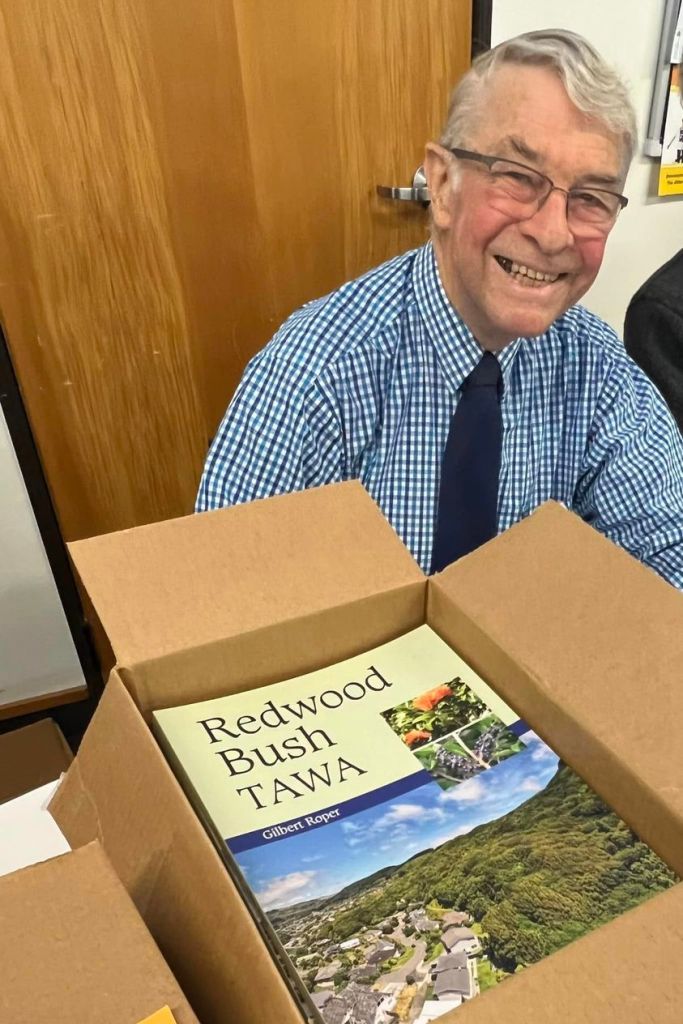
A very special Friends of Tawa Bush member, major contributor to this site, editor of many a newsletter, and provider of hugely informative guided walks. Gil is much missed by all, after his passing in February following a brief illness.
Gil’s obituary is available to read here


Norm Robertson

(d 2019 aged 83yrs)
Article from Tawa Link, Civic Awards 2010

Peter Saxton
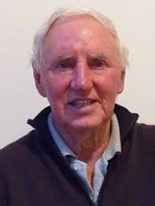
Article from Tawa Link, Civic Awards 2010

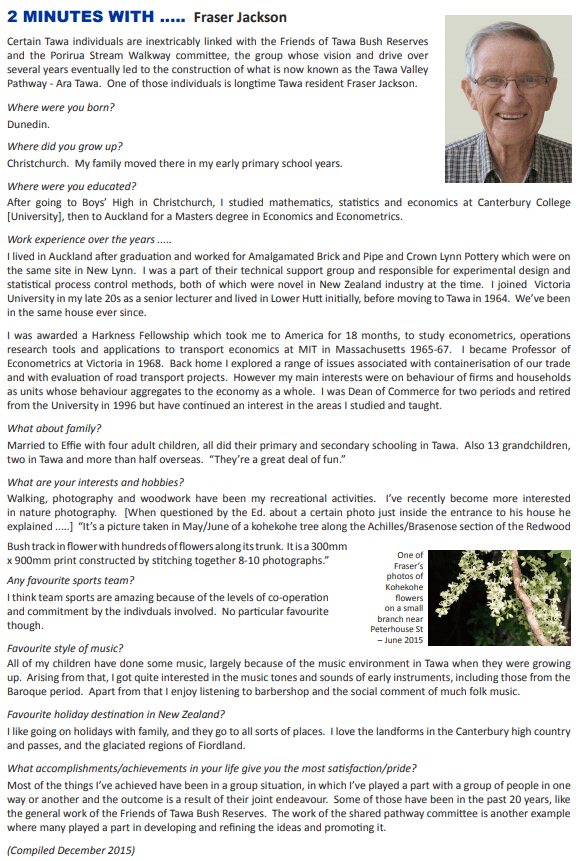
Fraser Jackson
(d 21 October 2021)
Tawa Link Article 2015
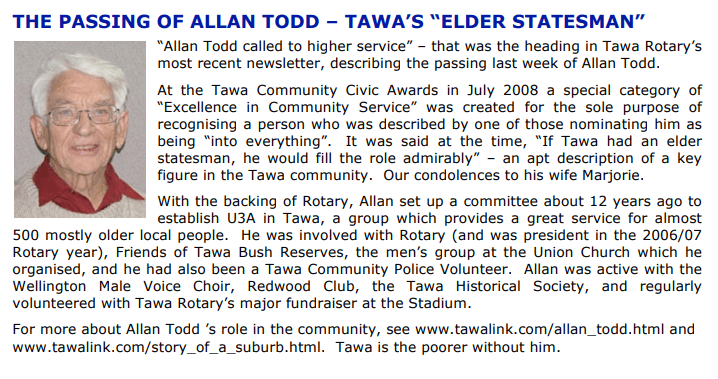
Allan Todd
(d 2013 aged 81yrs).
http://www.tawalink.com/2mins/tawanews_20130626.pdf
Dom Post/Tawa Link Jan 2010
Linkage to Council Strategies
The Friends contributes to and works in conjunction with many of the Wellington City Council and Greater Wellington policies and strategies that have impact on the bush and open areas in the Tawa area. These include the following: –
- Outer Green Belt Management Plan (public submissions were sought October 2003 – published May 2004, reviewed and reissued August 2019)
- Northern Reserves Management Plan – discussion document (public submissions sought late 2004 and March to May 2008, issued August 2008)
- Open Space Access Plan – also known as the City wide Track Plan (public submissions sought January 2004 – published December 2008, reviewed and reissued September 2016))
- Northern Growth Management Plan (first round of public submissions sought May 2002)
- Northern Growth Management Framework (further public consultation August 2003 – final Framework published February 2004)
- Wellington Wet And Wild – Bush And Streams Regeneration Plan 2001-2006 (an operative plan determining input to each Annual Plan during this period)
- Hilltop and Ridges policy (an evolving guiding policy as part of the keeping Wellington beautiful strategy)
- Greater Wellington – 2002-2022 Regional Pest Management Strategy
- Wellington City Pest Management Plan (public submissions sought March 2004 – published June 2004)
- Greater Wellington – 2019-2039 Regional Pest Management Plan
 Friends of Tawa Bush Reserves